Schema Markup for SEO: The Complete Beginner's Guide
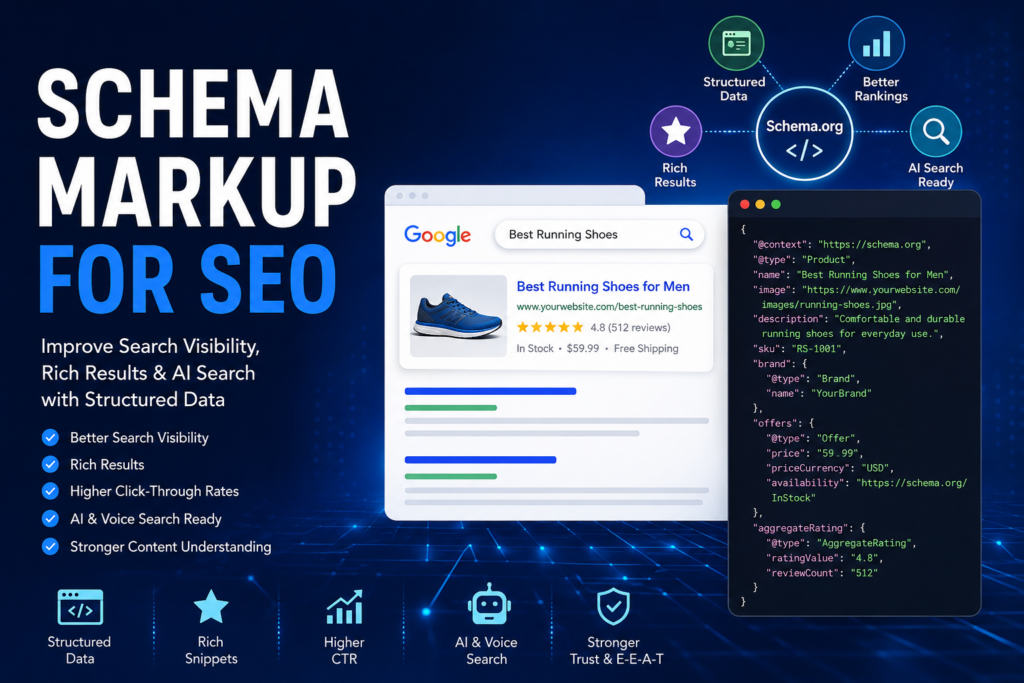
Introduction
Search engines have become much more sophisticated over the years, but they still need help understanding the meaning behind your content. While they can crawl text, images, and links, they may not always interpret the relationships between different pieces of information on a webpage. This is where Schema Markup for SEO becomes an essential part of a modern optimization strategy.
Schema markup is a form of structured data that provides search engines with additional context about your content. Instead of simply seeing a page full of text, search engines can identify whether the page is an article, product, review, recipe, business profile, event, or FAQ. This extra layer of information helps search engines display richer and more informative search results.
As someone who regularly works with SEO strategies and website optimization, I have found that schema markup is one of the most overlooked technical improvements. Many websites publish excellent content but miss opportunities to improve visibility because they fail to implement structured data correctly.
Beyond traditional SEO, structured data has become increasingly valuable for AI-powered search experiences. Platforms such as ChatGPT, Google AI, and Gemini rely on well-structured information to better understand web content. Implementing Schema Markup for SEO helps improve machine readability, making your content easier for both search engines and AI systems to interpret.
This guide explains everything you need to know about Schema Markup for SEO, including how it works, why it matters, the different schema types available, implementation methods, and best practices that can improve your website’s search performance.
What Is Schema Markup for SEO?
Schema Markup for SEO is a standardized vocabulary of structured data that helps search engines understand the meaning of information on a webpage.
Think of it as labels that explain your content.
Without schema, Google may recognize words like “Apple,” but it may not immediately know whether you’re talking about the technology company or the fruit.
With structured data, you explicitly tell search engines exactly what each piece of content represents.
For example, schema can identify:
- Blog articles
- Products
- Businesses
- Reviews
- Authors
- Events
- Recipes
- Videos
- FAQs
- Courses
This additional context allows search engines to display enhanced search results known as rich results or rich snippets.
Schema markup follows standards developed by Schema.org and is supported by major search engines including Google, Bing, Yahoo, and Yandex.
Why Schema Markup Matters
Adding structured data offers benefits that go far beyond improving search appearance.
It helps search engines understand the purpose of your content more accurately, increasing the likelihood that your pages qualify for enhanced search features.
Some of the key advantages include:
- Better content understanding
- Improved indexing
- Rich search results
- Increased click-through rates
- Better user experience
- Stronger topical relevance
- Improved visibility in AI-powered search
- Enhanced Knowledge Graph eligibility
While schema itself is not a direct ranking factor, it supports many signals that contribute to stronger SEO performance.
For businesses, implementing Schema Markup for SEO can lead to higher visibility and improved engagement without creating additional content.
How Search Engines Use Structured Data
Every time Google crawls a webpage, it attempts to understand what the page is about.
Without structured data, search engines rely mainly on headings, content, links, and metadata.
Structured data provides another layer of understanding.
Instead of guessing whether a number is a product price or a phone number, schema clearly defines it.
For example:
A page may contain:
4.9
Without schema, this is simply a number.
With Review Schema, Google understands it represents an average rating.
Similarly:
A page may include:
July 20
Without schema, Google simply sees a date.
With Event Schema, it recognizes the event date.
This improved understanding enables search engines to generate richer search experiences.
How Schema Markup Supports AI Search
Artificial intelligence systems work differently from traditional search engines.
Instead of simply matching keywords, AI platforms analyze context, relationships, and meaning.
Structured data makes this process easier.
Implementing structured data should be part of every Technical SEO Checklist because it helps search engines interpret your website more accurately.
When websites implement Schema Markup for SEO correctly, AI systems can more confidently identify:
- Business information
- Authors
- Products
- Services
- Frequently asked questions
- Reviews
- Educational resources
This additional clarity improves machine understanding.
As AI-generated search experiences continue growing, websites with organized, well-structured information are likely to gain greater visibility.
Schema does not guarantee AI citations, but it significantly improves content clarity for machine learning systems.
Common Types of Schema Markup
Not every website needs every type of schema.
The best approach is choosing structured data that accurately represents your content.
The most widely used schema types include:
Article Schema
Used for blog posts, news articles, and educational content.
Ideal for websites publishing regular articles.
FAQ Schema
Helps search engines understand frequently asked questions.
Can improve visibility when users search specific questions.
Organization Schema
Provides information about your business including name, logo, website, and contact details.
Useful for building brand recognition.
Local Business Schema
Perfect for businesses serving specific geographic locations.
Includes:
- Address
- Phone number
- Business hours
- Reviews
- Location
Product Schema
Essential for ecommerce websites.
Can display:
- Price
- Availability
- Ratings
- Reviews
Review Schema
Allows search engines to understand ratings and customer reviews.
Breadcrumb Schema
Improves navigation understanding for both users and search engines.
Person Schema
Useful for author pages and personal brands.
Helps establish credibility and authority.
Video Schema
Improves visibility for video content.
Can display duration, upload date, and thumbnail information.
Course Schema
Helpful for educational websites offering online courses or certifications.
Comparison Table
| Schema Type | Best For | Main Benefit |
|---|---|---|
| Article | Blogs | Better indexing and content understanding |
| FAQ | Help pages | Rich search results |
| Organization | Company websites | Brand recognition |
| Local Business | Local SEO | Local search visibility |
| Product | Ecommerce | Product rich results |
| Review | Reviews | Star ratings in search |
| Breadcrumb | Website navigation | Better crawlability |
| Person | Author pages | Authority and trust |
| Video | Video content | Enhanced video visibility |
| Course | Online learning | Educational rich results |
Why Every Website Should Use Schema
Whether you run a personal blog, an ecommerce store, a local business website, or a digital marketing agency, structured data helps search engines understand your content more effectively.
Schema Markup for SEO improves communication between your website and search engines by providing explicit information instead of relying on assumptions.
It also creates a stronger technical foundation that supports future SEO strategies, AI-powered search experiences, and improved user engagement.
JSON-LD vs. Microdata vs. RDFa
There are several ways to implement structured data on a website. Although all methods help search engines understand your content, they differ in how the code is added.
JSON-LD
JSON-LD (JavaScript Object Notation for Linked Data) is Google’s recommended format for implementing structured data. It keeps the schema code separate from the visible HTML, making it easier to manage and update.
Advantages of JSON-LD include:
- Easy to implement
- Cleaner website code
- Recommended by Google
- Less likely to create errors
- Simple to update without changing page content
For most websites, JSON-LD is the preferred choice.
Microdata
Microdata places structured data directly inside HTML elements. While it is still supported, it makes the website code more complex and harder to maintain.
Microdata may still be found on older websites, but it is generally not recommended for new implementations.
RDFa
RDFa is another structured data format that embeds metadata into HTML attributes. It is commonly used in specialized web applications but is less popular for general SEO purposes.
For most businesses and WordPress websites, JSON-LD offers the best balance of simplicity and performance.
How to Add Schema Markup to a WordPress Website
Implementing Schema Markup for SEO is easier than many website owners expect. WordPress users have several options depending on their technical knowledge and the tools they use.
Use an SEO Plugin
Many SEO plugins automatically generate basic structured data.
Popular options include:
- Rank Math
- Yoast SEO
- All in One SEO
These plugins can add Article Schema, Organization Schema, Breadcrumb Schema, and other common types without requiring manual coding.
Add Custom JSON-LD
Advanced users can add JSON-LD directly within the <head> section of a page or use a code snippets plugin. This approach offers greater flexibility when implementing custom schema types.
Use Dedicated Schema Plugins
If your website requires specialized structured data, dedicated schema plugins can simplify implementation. These plugins provide templates for products, FAQs, courses, recipes, events, and other content types.
Regardless of the method you choose, always verify that your structured data is valid after implementation.
How to Test Your Schema Markup
Adding structured data is only the first step. You should also verify that search engines can read it correctly.
Google’s Rich Results Test helps determine whether your page is eligible for rich results and identifies any implementation errors.
Schema validation tools can also highlight missing properties, incorrect formatting, or unsupported schema types.
Testing every important page ensures your structured data performs as expected and prevents hidden issues from affecting search visibility.
Best Practices for Schema Markup for SEO
Simply adding schema is not enough. Following best practices ensures your structured data provides maximum value.
Choose schema types that accurately represent your content rather than adding unnecessary markup.
Keep structured data consistent with the visible content on the page.
Update schema whenever content changes, especially for products, events, business information, and reviews.
Use only supported schema types and follow Google’s structured data guidelines.
Implement schema across your website wherever appropriate instead of limiting it to only a few pages.
Validate your schema regularly after website updates or redesigns.
These practices improve content clarity while supporting long-term SEO performance.
Common Schema Markup Mistakes
Many websites implement structured data incorrectly, reducing its effectiveness.
Some common mistakes include:
- Using schema that does not match the page content.
- Leaving required properties incomplete.
- Displaying different information in schema than what users see.
- Using multiple conflicting schema types.
- Forgetting to update structured data after content changes.
- Ignoring validation errors.
- Adding excessive or misleading structured data.
Avoiding these mistakes helps search engines trust your website and interpret your content accurately.
How Schema Supports Technical SEO
Schema Markup for SEO works alongside technical optimization rather than replacing it.
A technically optimized website provides search engines with fast loading pages, secure connections, responsive layouts, and efficient crawling. Structured data adds another layer by helping search engines understand the meaning of your content.
For example, Technical SEO ensures Google can access a page, while schema helps Google understand exactly what the page contains.
Together, these strategies create a stronger foundation for long-term organic growth.
Schema and AI-Powered Search
Artificial intelligence is changing how users discover information online.
AI-powered search platforms analyze websites differently from traditional search engines. Instead of relying only on keywords, they evaluate relationships between people, businesses, products, services, and topics.
Schema provides these relationships in a structured format.
When a webpage clearly identifies its author, organization, article type, FAQs, products, or services, AI systems can process that information more efficiently.
This structured approach improves machine understanding and supports AI-generated search experiences.
Although schema alone does not guarantee inclusion in AI-generated responses, it contributes to stronger content organization and improved discoverability.
Structured data also strengthens Generative Engine Optimization by making your content easier for AI systems to understand and reference.
Schema and E-E-A-T
Google emphasizes Experience, Expertise, Authoritativeness, and Trustworthiness when evaluating content quality.
Schema markup can strengthen these signals by providing additional information about your website and its authors.
For example:
- Organization Schema identifies your business.
- Person Schema connects authors with their expertise.
- Article Schema provides publication information.
- Review Schema highlights customer feedback.
- Breadcrumb Schema improves website navigation.
When combined with high-quality content and technical optimization, structured data helps reinforce your website’s credibility.
The Future of Schema Markup
As search engines continue integrating artificial intelligence into their ranking systems, structured data will become even more valuable.
Future search experiences will depend increasingly on understanding context rather than matching keywords alone.
Businesses that implement Schema Markup for SEO today will be better prepared for these changes.
Instead of treating structured data as an optional enhancement, website owners should view it as a core part of their long-term SEO strategy.
Conclusion
Schema Markup for SEO is one of the most valuable technical improvements a website can implement. It helps search engines understand your content, improves eligibility for rich results, strengthens technical SEO, and supports the future of AI-powered search.
Whether you operate a blog, an eCommerce store, a local business website, or a corporate platform, structured data provides additional context that benefits both users and search engines.
By implementing the correct schema types, following best practices, and regularly validating your structured data, you create a stronger foundation for long-term organic visibility.
Schema markup is not a shortcut to higher rankings, but it is a powerful tool that helps search engines interpret your content more accurately. Combined with quality content, technical SEO, and a consistent publishing strategy, it can contribute significantly to long-term search success.
Frequently Asked Questions
What is Schema Markup for SEO?
Schema Markup for SEO is structured data added to a webpage to help search engines understand its content more accurately. It can improve eligibility for rich results and enhance search visibility.
Does schema markup improve rankings?
Schema is not a direct ranking factor. However, it helps search engines better understand your content, which can improve visibility, click-through rates, and overall SEO performance.
Which schema type should I use for blog posts?
Article Schema is the most appropriate choice for blog posts. You can also add FAQ Schema, Breadcrumb Schema, and Person Schema where relevant.
Is JSON-LD better than Microdata?
Yes. Google recommends JSON-LD because it is easier to implement, maintain, and validate compared to Microdata.
How do I test schema markup?
Use Google’s Rich Results Test and the Schema Markup Validator to check for errors and confirm that your structured data is implemented correctly.